
NewsNEWCENTER
Featured products
Contact Us
The Diverter System of a water-ring vacuum pump
2026-10-22With the rapid development of urban construction, water-ring vacuum pumps are now widely used, and their numerous advantages have been widely recognised. To ensure their optimal application, let us take a look at the components of a water-ring vacuum pump’s flow-guiding system.
As a mainstream type of vacuum equipment, water-ring vacuum pumps require seamless coordination between various systems to fully utilise the water-ring vacuum extraction method. Among these, the flow guidance system determines the efficiency of the vacuum pump’s extraction; consequently, the flow guidance system of these pumps features a unique design. The umbrella-shaped nozzles in water-ring vacuum pumps are characterised by their diameter increasing progressively from one stage to the next, forming a tower-like structure. This is because the larger the gap between the nozzle and the vacuum pump wall, the greater the effective area for gas diffusion. Consequently, the nozzles at the inlet end are primarily designed to maximise the vacuum pump’s pumping speed. After undergoing primary compression, the gas pressure increases and its density rises, allowing it to pass through a smaller cross-sectional area. Consequently, the clearance between the nozzles in the subsequent stages and the vacuum pump wall is progressively reduced. This also prevents the gas, which is under increasingly higher pressure, from passing through the vapour stream and diffusing back towards the high-vacuum end, thereby reducing the vacuum pump’s ultimate pressure.
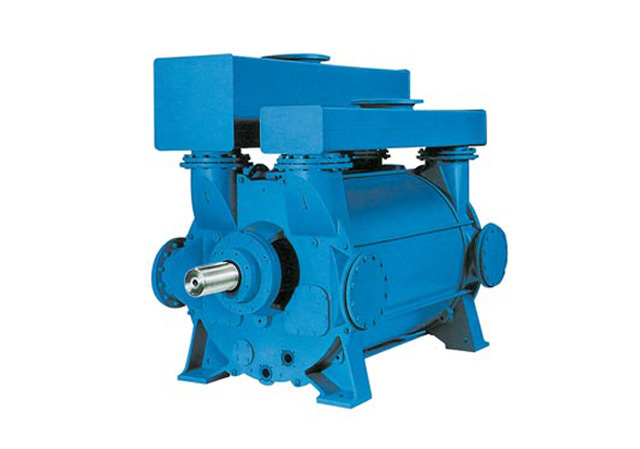
Water-ring vacuum pumps
In water-ring vacuum pumps, the clearance between the umbrella-shaped nozzles affects the flow rate of the oil vapour stream and the performance of the vacuum pump. Nozzle opening angle: if the opening angle is too large, the distance from the nozzle to the vacuum pump wall increases, preventing the formation of a sufficiently dense vapour stream near the pump wall; this enhances gas back-diffusion and impairs the vacuum pump’s pumping performance; if the opening angle is too small, the horizontal velocity of the oil molecules increases, which can easily cause oil vapour to be reflected back towards the high-vacuum end and impede the diffusion of gas molecules into the vapour stream, also resulting in a deterioration of the vacuum pump’s pumping performance. Generally, the opening angle is selected within a range of 50° to 80°; for vacuum pumps of different sizes and types, the specific value of the opening angle selected during design will vary.
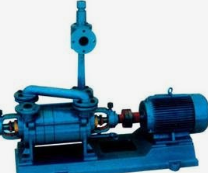
Water-ring vacuum pump ejection nozzles: In the final stage of diffusion vacuum pumps, ejection nozzles are utilised. Unlike umbrella-shaped nozzles, these have a shape that first tapers and then gradually expands, with a throat of small cross-sectional area in the middle. Such nozzles are typically paired with a diffuser to ensure that the vacuum pump can withstand higher outlet pressures. The use of an ejector nozzle and diffuser not only increases the vacuum pump’s maximum permissible outlet pressure but also enhances its pumping speed at medium pressures. Consequently, diffusion vacuum pumps generally employ a jet nozzle as the final stage, also known as the jet stage. As water-ring vacuum pumps typically generate significant pressure during operation, the equipment’s flow-guiding system must adopt the aforementioned umbrella-shaped structure to effectively increase the gas diffusion area, thereby minimising the pressure exerted on the equipment as much as possible and preventing damage.
The above information concerns the flow-guiding system of water-ring vacuum pumps. We encourage you to familiarise yourselves with this information so that you may select a suitable vacuum pump based on your actual requirements, thereby avoiding unnecessary complications arising from improper use. Should you have any queries, please do not hesitate to contact us; as a specialist manufacturer, we are able to provide you with expert advice.