
NewsNEWCENTER
Featured products
Contact Us
Points to Consider When Selecting a Liquid-Ring Vacuum Pump
2026-08-14Water-ring vacuum pumps are widely used across many sectors. With advantages such as a long service life and low investment costs, they are subject to relatively high performance requirements, which in turn places greater demands on the technology used. Let us now take a look at the key considerations when selecting a water-ring vacuum pump.
The operating pressure of a liquid-ring vacuum pump must meet the ultimate vacuum and operating pressure requirements of the vacuum equipment. For example, if a vacuum drying process requires a working vacuum of 10 mm, the selected vacuum pump should have an ultimate vacuum of at least 2 mm, and ideally 1 mm. Typically, the pump’s ultimate vacuum is between half and one order of magnitude higher than the working vacuum of the vacuum equipment. It is essential to select the correct operating point for the vacuum pump; each pump has a specific operating pressure range, and within this wide range, the pump’s speed varies with pressure. At its operating pressure, the vacuum pump should be capable of evacuating all gases generated during the vacuum equipment process. As vacuum pumps exhibit selective gas extraction, a single pump may sometimes fail to meet the evacuation requirements; a combination of several pumps, working in tandem to complement one another, may be necessary to fulfil these requirements. For example, a titanium sublimation pump has a high pumping speed for hydrogen but cannot pump helium, whilst a tri-electrode sputtering ion pump (or a di-electrode asymmetric cathode sputtering ion pump) has a certain pumping speed for argon, enabling the vacuum system to achieve a better vacuum level. Furthermore, some vacuum pumps cannot operate at atmospheric pressure and require a pre-vacuum; others have an outlet pressure below atmospheric pressure and require a fore-vacuum pump, thus necessitating the use of a combination of pumps.
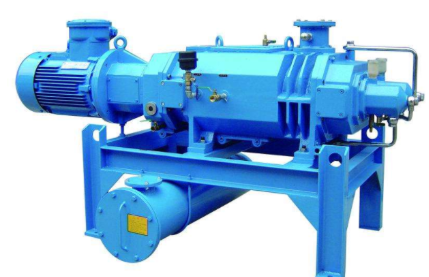
With regard to oil contamination from liquid-ring vacuum pumps, if the equipment requires strict oil-free operation, various oil-free pumps should be selected, such as liquid-ring pumps, molecular sieve adsorption pumps, sputter ion pumps and cryogenic pumps. If the requirements are not stringent, oil-lubricated pumps may be selected, provided that measures to prevent oil contamination—such as cooling traps, baffle plates and oil separators—are implemented; this can also satisfy the requirements for a clean vacuum. It is essential to understand the composition of the gas to be evacuated, including whether it contains condensable vapours, particulate matter or corrosive substances. When selecting a vacuum pump, one must be aware of the gas composition and choose a pump appropriate for the specific gas being evacuated. If the gas contains vapour, particulates or corrosive gases, consideration should be given to installing auxiliary equipment on the pump’s inlet duct, such as condensers or dust collectors. What impact do the oil vapours discharged by the vacuum pump have on the environment? If environmental regulations prohibit pollution, an oil-free vacuum pump may be selected, or the oil vapours may be vented outdoors. Does the vibration generated by the vacuum pump during operation affect the process or the environment? If the process does not permit this, a vibration-free pump should be selected or anti-vibration measures implemented.
The above outlines key considerations for selecting water-ring vacuum pumps. We encourage you to familiarise yourselves with these points, as the wide range of advantages offered by these pumps means they are being used in an increasingly diverse range of applications. Should you have any queries, please do not hesitate to contact us; we will provide professional advice to help you avoid losses resulting from improper use.